Mostrando las entradas con la etiqueta Belleza. Mostrar todas las entradas

10 de enero de 2026

490

«Everything made by man's hands has a form, which must be either beautiful or ugly; beautiful if it is in accord with Nature, and helps her; ugly if it is discordant with Nature, and thwarts her.»

William Morris (1834-1896)

William Morris, essay and lecture entitled "The Lesser Arts", originally delivered in 1877 and later published in his 1882 collection, "Hopes and Fears for Art".
Image: Morris & Company, London (1861-1940), Acanthus portière, silk embroidery on linen, 1890s.

14 de noviembre de 2024

473

«A thing is right when it tends to preserve the integrity, stability, and beauty of the biotic community. It is wrong when it tends otherwise.»

Aldo Leopold (1887-1948)

Aldo Leopold, A Sand County Almanac, 1949, p. 262, as quoted in Wikipedia.
Image: Aldo Leopold on a bow hunting trip to the Rio Gavilán, Northern Mexico, 1938 (Public Domain).

17 de agosto de 2024

468

«Tras pensarlo mucho llegué a la conclusión de que diseñar es ordenar y de que el diseño consiste en cumplir una función manteniendo la emoción, la emoción estética. Todo lo que soluciona con belleza es un buen diseño. Lo que consigue estética sin función es otra cosa. En el diseño tienen que darse a la vez ambos: solución y belleza. No vale entorpecer con belleza. La belleza nace de la gracia, de evitar, precisamente, la torpeza.
Cuando era joven me daba vergüenza reconocer, y ya no digamos afirmar, que me importaba la belleza, que consideraba esencial la parte estética de las cosas. Ahora me enorgullezco de haberla cuidado. También de decirlo. Y hasta de repetirlo: la estética es lo más importante. La función se da por hecha. Pero la emoción estética enriquece la compañía.»

Miguel Milá (1931-2024)

Miguel Milá, Lo esencial: El diseño y otras cosas de la vida, Editorial Lumen, 2019.

31 de mayo de 2024

455

«What is good design in your eyes?»

«The nearest I have ever come to defining good design is that it is simply 98 per cent common sense. But what makes the subject so interesting is the other two per cent, what you may call aesthetics. Many products are demonstrably good, but those with that extra two per cent have a magic ingredient that places them in another category altogether – it is the difference between something that is perfectly acceptable and something that is so special that everybody wants to own it.»

«When the magic ingredient is present, the whole quality of life is improved. Good design gives you pleasure and improves the quality of all our lives through products that work well, are affordable and look beautiful. As Corbusier said, good design really is simply intelligence made visible.»

Sir Terence Conran (1931-2020)

Interview: Sir Terence Conran on Democratising Good Design, The Design Sheppard, February 1, 2012. Contribución de Cristina Fernández Marcos, Taller de Diseño, Universidad de Navarra, 28 mayo 2024.

31 de enero de 2024

442

«I think perfection is ugly. Somewhere in the things humans make, I want to see scars, failure, disorder, distortion.»

Yohji Yamamoto (Tokio, 1943)

Yohji Yamamoto, Talking to Myself. Yohji Yamamoto, Kiyokazu Washida. Carla Sozzani Editore, 2002.

17 de diciembre de 2023

437

«Art has poisoned our life. Aesthetics has infected everyone... If one chooses a typewriter or a sewing machine in the living room, the housewife say: 'Please take it away; it destroys the harmony of the room'. Post-cards, stamps, pouches, railway-tickets, pots umbrellas, towels, pyamas, chairs, blankets, handkerchiefs and ties – everything is 'arty'. How much more refreshing are those articles which are not called art: bathrooms, bath-tubs, bicycles, automobiles, engine-rooms and flat-irons. There are still people who can make beautiful things without art. They are the progressives.»

Theo van Doesburg (1883-1931)

Quote of Van Doesburg in his article: 'The end of art'; in 'De Stijl' series XII, 1924-5, pp. 135–136.

24 de octubre de 2023

430

«Non v'è più bellezza, se non nella lotta. Nessuna opera che non abbia un carattere aggressivo può essere un capolavoro. La poesia deve essere concepita come un violento assalto contro le forze ignote, per ridurle a prostrarsi davanti all'uomo.»

Filippo Tommaso Marinetti (1876-1944)

Filippo Tommaso Marinetti, Manifesto del Futurismo, 1909.

8 de octubre de 2023

427

«If you can paint one leaf, you can paint the world.»

John Ruskin (1819-1900)

John Ruskin (1843–1860), Modern Painters, Volume V, Part VI. Of Leaf Beauty, Project Gutemberg.

4 de octubre de 2023

426

«What is impractical can never be beautiful.»

Otto Wagner (1841-1918)

Otto Wagner (1902). “Modern Architecture: A Guidebook for His Students to This Field of Art”, Getty Publications, 1988, p.82.

18 de noviembre de 2022

405

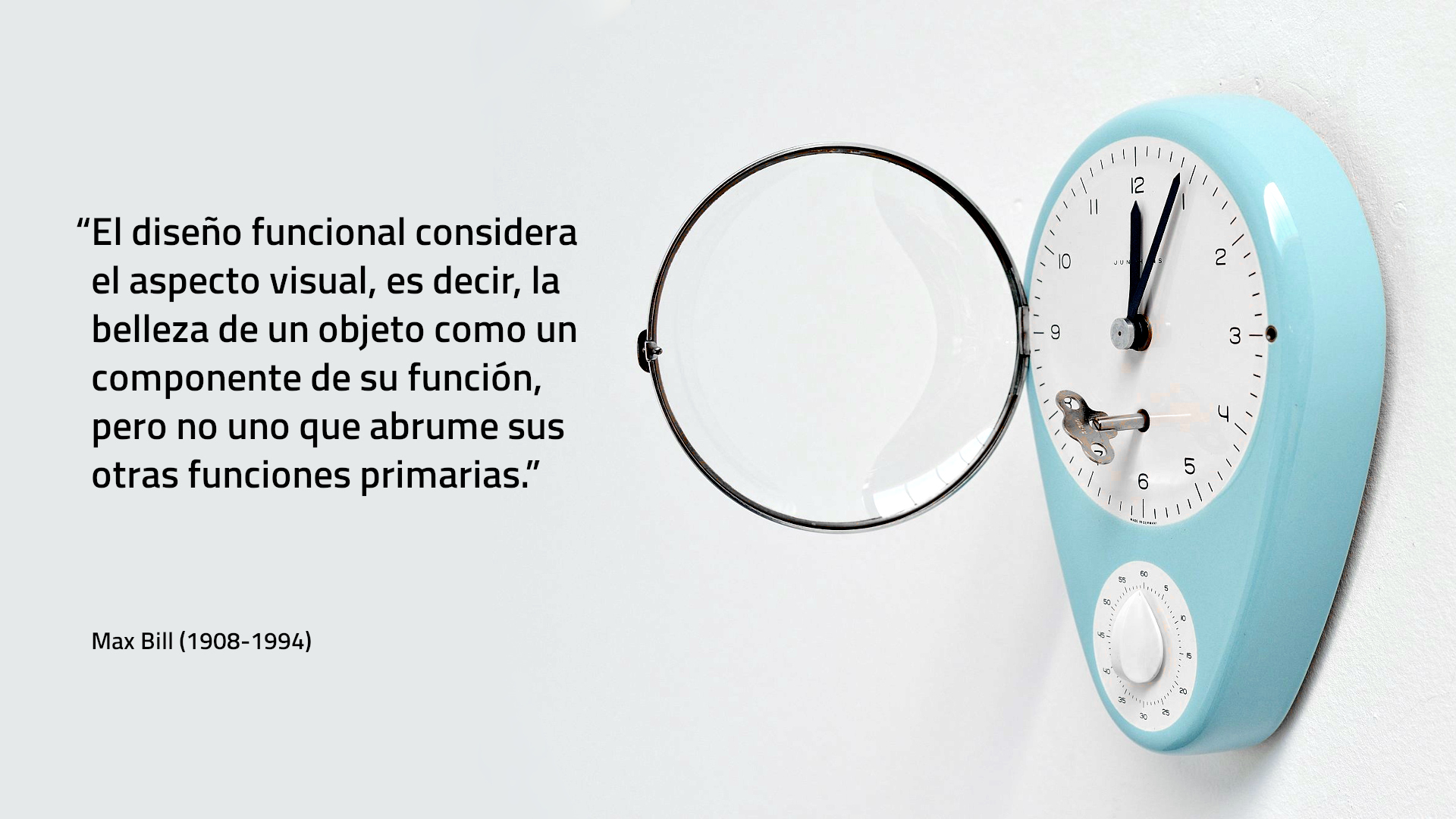
«Functional design considers the visual aspect, that is, the beauty, of an object as a component of its function, but not one that overwhelms its other primary functions.»

Max Bill (1908-1994)

As quoted in Gallery label from Counter Space: Design and the Modern Kitchen, September 15, 2010 – March 14, 2011. MoMA Collection: Max Bill, Kitchen Clock, 1956-1957.

20 de febrero de 2021

348

«Companies insist on printing critical instructions in tiny fonts with very low contrast. Labels cannot be read without flashlights and magnifying lenses. And when companies do design things specifically for the elderly, they tend to be ugly devices that shout out to the world “I’m old and can’t function!” We can do better.»

Donald A. Norman

Donald A. Norman, I wrote the book on user-friendly design. What I see today horrifies me, FastCompany, The New Business of Growing Old, 05 August 2019.

27 de mayo de 2020

328

“La mejor manera de evitar el levantamiento traumático del futuro contra sus creadores es introduciendo hoy la esperanza como variable fundamental del diseño. Y junto a la esperanza, incorporar el error y el capricho, el pensamiento crítico y el Arte, la compasión improductiva, la vulnerabilidad y el respeto, la belleza y la amabilidad, lo imaginativo, lo inocente, lo inolvidable y lo intangible, la sensibilidad y la sabiduría, la inutilidad de los significados y el ruido mágico e imprevisible del sentido como parte fundamental de nuestros procesos de creación, de nuestra manera de innovar y de construir los escenarios y los artefactos con los que se sueña el mañana.”

Alberto Barreiro

Futuros en busca de sentido. Retina, El País, 25 Nov. 2019.

12 de abril de 2020

324

“El futuro pertenece a los que creen en la belleza de sus sueños.”

Eleanor Roosevelt

Citada por Michio Kaku (2014), El Futuro de Nuestra Mente. El reto científico para entender, mejorar y fortalecer nuestra mente. Título original: The Future of the Mind. Traducción: Juan Manuel Ibeas Delgado y Marcos Pérez Sánchez, Debate, Penguin Random House Grupo Editorial, Barcelona, 2014, p. 227.

8 de marzo de 2020

316

«The pleasure of making things beautiful or useful involves your feelings as well as your thinking. When your original sketch evolves into a tangible, three-dimensional object, your heart is anxiously following the process of your work. And the love involved in making it is conveyed to those for whom you made it.»

Eva Zeisel (1906-2011)

22 de febrero de 2020

312

"The biggest issue in design is not beauty or aesthetics, it’s relevancy. Relevancy takes the subjective state of the human using the object, and projects it on to the object. What is this object doing for me? We should educate young designers and the designers of the future to hone that sense of relevancy."

Gadi Amit
The future of design, WIRED in partnership with BRAUN, 20 August 2018.

10 de febrero de 2020

306

"It is in truth that we find beautiful things, and it is in truth that we can operate authentically. One might have the head of an engineer, but one must always quest with the heart of a poet."

Alan Moore
Do Design. Why beauty is key to everything, Do Book Co., 2016. Thanks to Diego Rodríguez @arketipo
Quoted by Alan Moore, A quest for truth is always core to the purpose of a poet. Remembering Seamus Heaney, Beautiful Business, 13th April 2018.

1 de febrero de 2020

303

Design confuses both designers and non-designers
  • The value of design is in relation to the other parts of a company’s operations.
  • Alone and isolated within a company, design is a microworld of aesthetic high-fives.
  • The complexity of design interests designers, but the rest of your org doesn’t care.
  • Design is all too often used as an attractive costume for a so-so idea.


John Maeda
2019 Design in Tech Report | Section 2 | About Design-Organizations. Page 23. March 10, 2019.

12 de marzo de 2009

281

"Il buono coincide con l’equilibrio tra forma e funzione dell’oggetto. Il brutto è quello che trasforma un oggetto solo in un utensile, che non da godimento all’occhio o alla mente."

Achille Bonito Oliva
In occasione della mostra «Il buono, il brutto e il cattivo. Il good design tra storia e futuro»
La Repubblica, 09 Marzo 2009, Quella sedia è buona, la libreria è cattiva i critici rivelano l’anima dietro alle forme, da Irene Maria Scalise.

10 de diciembre de 2008

265

"Don't make something unless it is both necessary and useful; but if it is both necessary and useful, don't hesitate to make it beautiful."

"No hagas nada a no ser que sea a la vez necesario y útil. Pero si es realmente necesario y útil, no dudes en hacerlo bonito."

Shaker proverb

Probably more remembered by their design achievements than by their religious beliefs, the United Society of Believers in Christ’s Second Appearing, known as the Shakers, was a Protestant religious denomination that originated in Manchester, England in 1747.

El proverbio Shaker ha sido adoptado como lema por Design House Stockholm y, por extensión, se ha convertido también en el lema del diseño nórdico en general, según se recoge en El País Semanal, Domingo 2 de noviembre de 2008, Nº 1.675, p. 84, Lo nórdico se reinventa, por Anatxu Zabalbeascoa.

4 de noviembre de 2008

255

"En réalité, elle ne se résignait jamais à rien acheter dont on ne pût tirer un profit intellectuel, et surtout celui que nous procurent les belles choses en nous apprenant à chercher notre plaisir ailleurs que dans les satisfactions du bien-être et de la vanité. Même quand elle avait à faire à quelqu’un un cadeau dit utile, quand elle avait à donner un fauteuil, des couverts, une canne, elle les cherchait «anciens», comme si leur longue désuétude ayant effacé leur caractère d’utilité, ils paraissaient plutôt disposés pour nous raconter la vie des hommes d’autrefois que pour servir aux besoins de la nôtre."

Marcel Proust (1871- 1922)
À la recherche du temps perdu, Tome I, Du côté de chez Swann, Gallimard, 1919.